| |

|
|
|
|
rProcess // INDUSTRY INSIGHTS
ADAS & AI Data Engineering Insights
How the evolution of ADAS is redefining what training data has to be, from labelled objects to reasoning and action
August 2026
|
|
| |
|
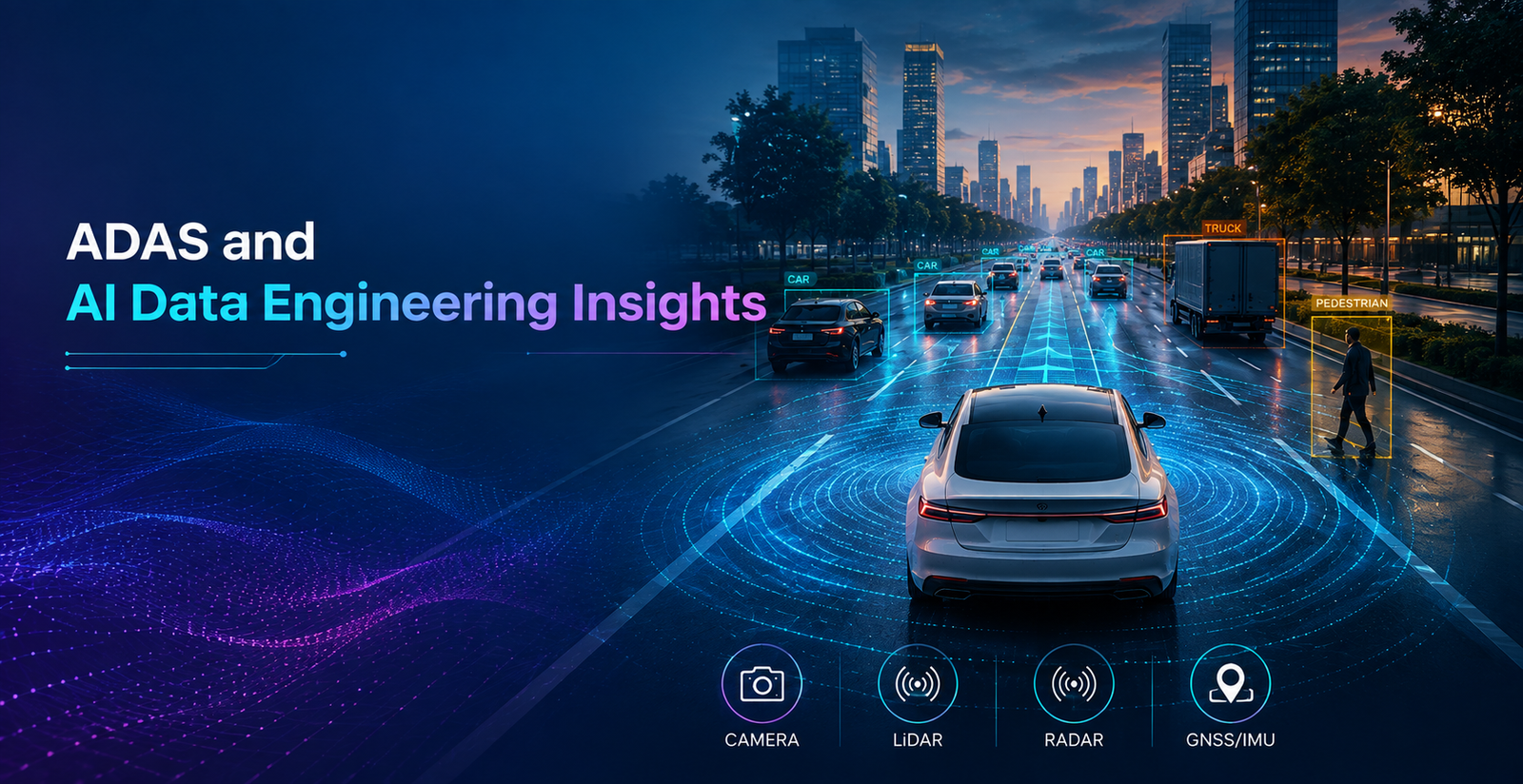
Autonomous driving is entering a phase where the constraint is no longer how much sensor data a fleet can collect, but how well that data is structured, synchronized, and made legible to reasoning systems. This issue traces that shift, from the emergence of Vision-Language-Action (VLA) models to the object-detection era of classical ADAS and looks at what it means for teams building and validating driving data today.
|
|
1. VLA & Reasoning AI in ADAS
|
|
|
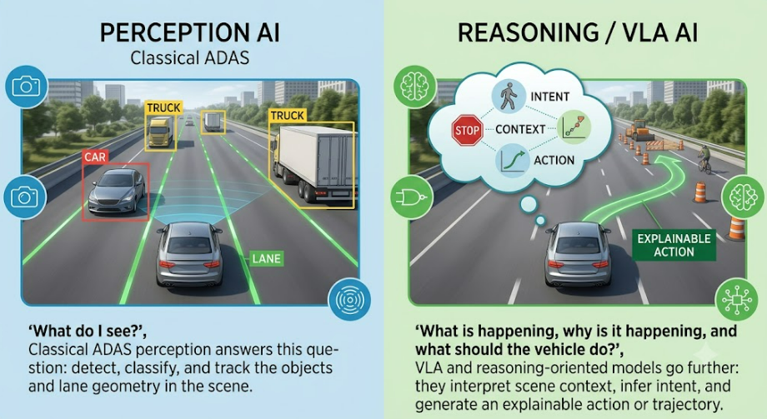
The most consequential development in autonomous driving research over the past two years has been the emergence of Vision-Language-Action (VLA) models, architectures that combine visual perception, natural-language-style reasoning, and action generation inside a single framework, rather than treating them as separate modules. A growing body of academic work now formalizes this as its own category ("VLA4AD"), distinct from both classical perception models and earlier vision-to-action policies that mapped pixels straight to steering and throttle without any explicit reasoning step.
|
|
|
Research groups including academic labs and AV developers are actively building toward this: recent work explores VLA "world models" that imagine a plausible next frame and reason over that imagined future to refine a driving trajectory, and other efforts add explicit 3D geometry as a fourth modality alongside vision, language and action so that reasoning stays grounded in the physical scene rather than drifting into plausible-sounding but spatially incorrect language.
Industry deployments are following a similar trajectory.
|
- Li Auto: Li Auto released what it described as the world's first VLA driver model in September 2024, with its MindVLA architecture integrating spatial intelligence, language intelligence, and behavioral intelligence, and mass production implementation planned for 2026. (Source)
- XPeng: XPeng officially rolled out its VLA 2.0 intelligent driving system in March 2026, an end-to-end architecture translating perception directly into driving decisions, with Volkswagen signed on as the first external launch partner and the same foundation model applied across robotaxis, humanoid robots, and its flying-car programme. (Source)
- DeepRoute.ai: DeepRoute.ai unveiled a 40-billion-parameter VLA foundation model at NVIDIA's GTC 2026 that collapses perception, prediction, planning, and control into a single unified network, targeting one million vehicle deployments by the end of 2026. (Source)
|
|
Analyst commentary projects VLA-centric end-to-end approaches taking a substantial share of higher-level automated driving systems by the end of the decade. These are useful directional signals about where engineering effort is concentrated, not settled market outcomes.
|
|
2. Industry Pulse: What Moved in July–August 2026
|
|
|
A snapshot of recent, verifiable developments across autonomous vehicles, ADAS supply, AI/data platforms, and regulation, the kind of signals that shape what OEMs and Tier-1s will need from their data partners over the next 12–18 months.
|
| |
|
Autonomous Vehicles & Robotaxis
|
|
- WeRide posts strong overseas growth: WeRide reported Q2 2026 revenue of RMB231.7 million, up 82.2% year over year, with overseas revenue climbing 164.4% and gross margin widening to 37.5% from 28.1%, a sign that L4 fleet expansion outside China is starting to show up in the numbers. (Source)
- Wayve clears London's licensing bar: Transport for London granted Private Hire Vehicle licenses to Wayve's autonomous Ford Mustang Mach-E fleet, completing the regulatory "triple lock" and clearing the way for Uber autonomous rides in the capital. (Source)
- Waymo posts favorable IIHS safety data: A new IIHS study found Waymo's driverless vehicles crash 68% less often than human drivers across four U.S. cities, though the authors flagged gaps in national crash-reporting data that limit broader comparisons. (Source)
- Mobileye founder to step down as CEO: Mobileye founder Amnon Shashua will step down as CEO after 27 years once a successor is named; the board has offered him the Chairman role so he can focus on long-term technology and humanoid robotics. (Source)
- Marti, Tensor expand to Türkiye: Marti Technologies signed a multi-year deal with Tensor to deploy Level 4 vehicles across the 20 Turkish cities where Marti's ride-hailing platform already operates. (Source)
|
| |
|
ADAS Supply Chain & Sensors
|
|
- AEye lidar validated on NVIDIA Thor: AEye validated its Apollo lidar sensor on NVIDIA DRIVE AGX Thor, confirming DriveOS interoperability and positioning the company within the NVIDIA DRIVE Hyperion ecosystem. (Source)
- Innoviz lands highway-perception OEM program: Innoviz will develop and validate a LiDAR-based perception stack for highway driving with an unnamed top-10 global automotive OEM, pairing InnovizTwo hardware with perception software on NVIDIA compute. (Source)
- BMW names Qualcomm lead compute partner: BMW Group named Qualcomm its lead compute silicon provider for digital cockpit and ADAS/AD systems, covering model programs under the Snapdragon Digital Chassis portfolio starting next decade. (Source)
- Mobileye, Stellantis expand ADAS supply deal: Mobileye will supply Cloud-Enhanced ADAS and REM crowdsourced mapping to select future Stellantis vehicles starting in 2027, extending hands-free driving features across a map network that already covers most U.S. and European roads. (Source)
|
|
|
- NVIDIA opens Alpamayo 2 Super reasoning model: NVIDIA opened Alpamayo 2 Super for commercial use under an open model-weights license, releasing a reasoning model roughly triple the scale of its predecessor for robotaxi and AV development workflows, a direct signal that reasoning-centric foundation models are moving from research to production tooling. (Source)
- TIER IV to open-source L4 AI chip design: TIER IV joined a Japanese government-backed R&D program and plans to open-source the logic design, compiler and toolchain for a Level 4 autonomous-driving AI chip. (Source)
- Applied Intuition launches Dana platform: Applied Intuition launched Dana, an agentic platform for physical AI development that the company says has compressed critical vehicle-development phases from months to days. (Source)
|
|
|
- NHTSA funds first federal AV standards: NHTSA will fund a $5 million, three-year consortium to develop the first federal AV performance standards, alongside streamlined Part 555 exemption processes and updated developer guidance. (Source)
- NHTSA presses AV developers on first-responder interference: NHTSA issued a formal call to action requiring AV developers to address a pattern of vehicles interfering with first responders, giving companies a defined window to respond. (Source)
|
|
3. The Future of ADAS Data Engineering
|
|
|
The throughline across the sections above is a single shift: ADAS data engineering is moving from a "more data" mindset to a "better-engineered data" mindset. This does not mean data volume stops mattering, long-tail coverage still requires scale. It means volume alone is no longer the primary lever for model improvement, and teams that treat it as one will spend heavily for diminishing returns.
Several capabilities are becoming the real differentiators for teams building AI training data for automotive and robotics applications:
|
|
|
Multimodal dataset construction: Coherently combining camera, LiDAR, radar and, increasingly, language annotations within a single, aligned scene representation. |
|
|
Data curation: Selecting and weighting data for diversity and relevance rather than treating every collected mile as equally valuable. |
|
|
Sensor synchronization: Treating sub-frame timing alignment across sensors as a quality gate, not a one-time calibration step. |
|
|
High-density data processing: Tooling and infrastructure built for dense, multi-sensor scenes rather than adapted from single-image workflows. |
|
|
Temporal consistency: Maintaining object identity and event continuity across long sequences, which reasoning and prediction models depend on. |
|
|
Automated quality checks + expert validation: Automated checks catch systematic errors at scale; expert review catches the ambiguous, safety-relevant cases automation misses. Neither replaces the other. |
|
|
Scene understanding and reasoning data: Structured, relationship-rich descriptions of scenes, not just object lists, to support reasoning-oriented training. |
|
|
Action and trajectory data: Explicit trajectory and decision-context annotation that connects a reasoning layer to a concrete driving action. |
|
|
Edge-case discovery: Deliberately identifying and prioritizing rare, safety-critical scenarios rather than relying on incidental collection. |
|
|
Continuous dataset improvement: Feeding validated model failures and disagreements back into the data pipeline as a standing process, not a one-off cleanup. |
|
|
The next generation of autonomous driving will not be built only on bigger models.
It will be built on better-engineered data.
|
|
|
|
4. Case Study: High-Density LiDAR Datasets (Overview)
|
|
|
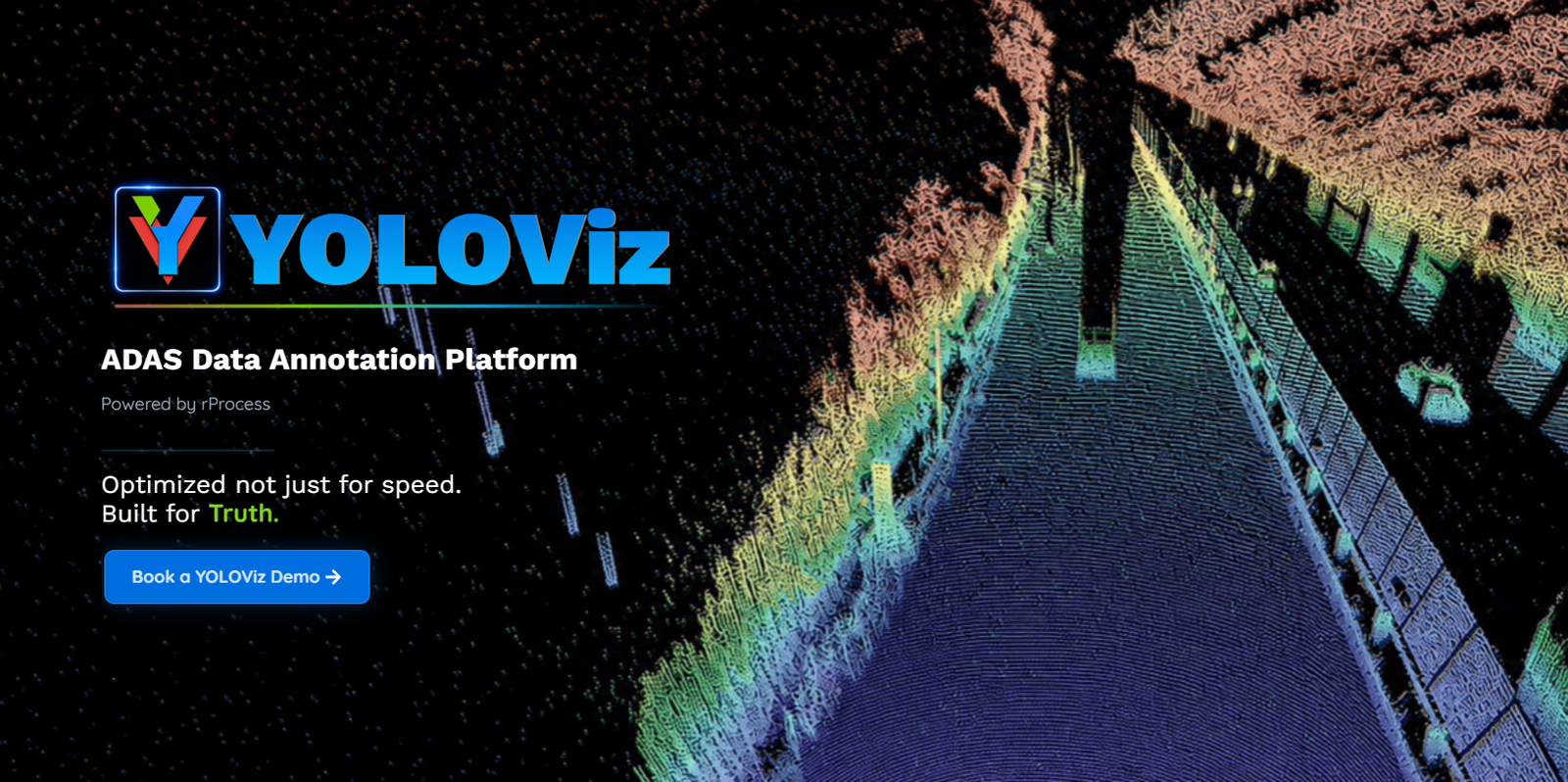
rProcess’ experience working on large-scale ADAS annotation programs, spanning multi-camera surround views, LiDAR point clouds, and long recorded driving sequences, surfaces a consistent pattern: the operational difficulty of a dataset scales faster than its raw size. High object density, multi-sensor calibration, track continuity across occlusion, and GPU-intensive 3D visualization all compound as datasets grows, which is why generic, single-image annotation tooling breaks down well before scaling limits are reached.
This is the operating environment rProcess’ YOLOViz platform is built for: a workflow purpose-built for high-density, multi-sensor ADAS scenes rather than adapted from single-image tools. The platform's role is less about labeling faster in isolation and more about keeping density, synchronization, and track continuity from degrading label quality as scenes get harder. (Learn more)
|

|
|
Prefer a quick discussion?
|
|
We're happy to connect and explore how we can support your next initiative.
|
|
LinkedIn
|
Facebook
|
YouTube
|
Instagram
|
|
Visit our website:
rprocess.ai
|
rprocessdesigns.com
|
|
© 2026 rProcess Outsourcing Services Pvt. Ltd. All Rights Reserved.
|
|
You are receiving this email because you are a valued partner or subscribed to our updates.
|
|
|